the short version
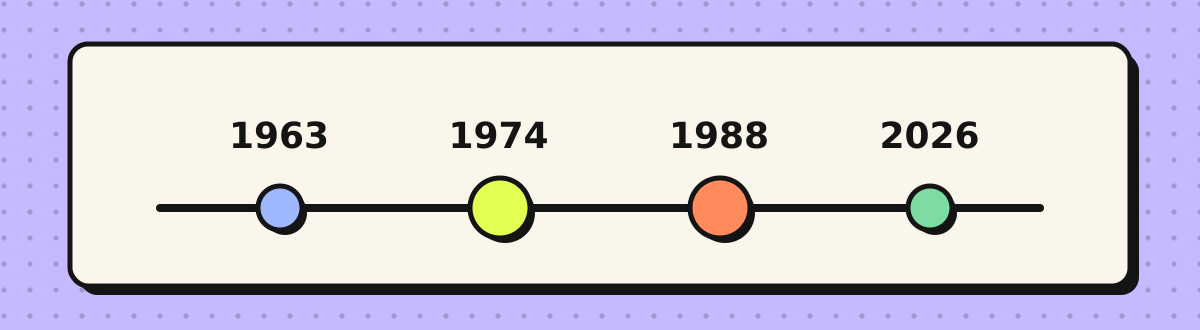
- until 1974, women could be legally denied a credit card, mortgage, or loan without a man's signature. that's your mother's lifetime.
- until 1988, a woman needed a male relative — husband, father, or her own son — to co-sign a business loan.
- credit is a record over time. a clock that starts in 1974 for half the population compounds into the wealth gap you're standing in.
- only in 2026 did most states (39) require a personal finance class to graduate high school — roughly one generation too late for you.
- the "women know less about money" gap is mostly a confidence gap: women pick "I don't know" instead of guessing, and financial education closes it entirely.
a question worth sitting with: how old is your mother?
Because if she was born before 1956, she reached adulthood in a country where a bank could hand back her credit application and ask for her husband's signature. Not as a rude manager going rogue. As policy.
On October 28, 1974, President Ford signed the Equal Credit Opportunity Act. Before that day, women could not get mortgages, business loans, or credit cards in their own names. Banks were legally allowed to deny women credit outright, or charge more, if they couldn't produce a male cosigner.
That is not ancient history. That is fifty-two years ago — your mom's lifetime, and possibly the first stretch of it.
1974
a credit card in her own name, without a man's signature
1988
a business loan without a male relative co-signing
2026
the year 39 states finally require personal finance to graduate
You're somewhere in that gap. Which is exactly where this site starts.
how recent this actually is
Every date here is within living memory. That is the entire argument of this piece.
what the application actually looked like
The National Archives has the receipts. A woman applying for a card or a loan could expect a round of personal questions about her marital status, and whether she had an available and willing male cosigner — a husband, brother, father, uncle, or friend.
The stated logic, when anyone bothered to say it out loud, was that a woman was a repayment risk because she might have a baby and stop working. Married women were denied regardless of their own income; single women were denied loans outright or approved for smaller amounts than single men with identical financial backgrounds.
the part that compounds
You cannot build a credit history you are not allowed to have. Credit is a record, and a record needs time. If the clock doesn't start until 1974, then everything downstream — the score, the mortgage rate, the inherited house, the casual advice to "just get a cosigner" — starts late too.
the women who wrote the law had been denied by it
The ECOA didn't appear because banks had a change of heart. A broad coalition of women's and civil rights groups pushed it through — and one of the people driving it was Margaret Heckler, who arrived in Congress in 1967 as a lawyer and an elected representative with no right to credit in her own name.
In 1974, sixteen women served in the House and none in the Senate. Three sat on the committee where any credit legislation had to pass: Heckler, Leonor Sullivan, and Corinne "Lindy" Boggs. Heckler wrote the draft; Boggs, not yet through a full term, amended it. The bill itself was originally written by Emily Card, a legislative fellow working for Senator Bill Brock.
Four women, essentially, against the entire consumer credit industry. Their names are in almost no textbook. If that pattern sounds familiar — women doing the work, the credit landing elsewhere — that's the Matilda effect, and it's why this site is named what it's named.
then it happened again, fourteen years later
Getting a personal credit card is one thing. Financing a business is another, and that door stayed shut until the Reagan administration.
The Women's Business Ownership Act of 1988 ended state laws requiring women to have a male relative sign their business loans. The definition of "male relative" was loose — it could be a husband, or it could be her own son.
During the congressional hearings, one witness testified that she had no husband, brother, or living father available, so her 17-year-old son co-signed her loan. He couldn't vote. He could vouch for his mother's money.
1988. The year before the World Wide Web.
what this means for your actual life
Generational wealth had a head start you weren't in. Property, business equity, and compounding all needed access to credit to begin — and half the population got the starting gun in 1974.
Nobody in your family may have the answer either. If your grandmother never held a card in her own name and your mother learned by trial and error, the dinner-table money talk had nothing to pass down.
The shame is misfiled. Not knowing how a Roth IRA works is a gap in your information, not a flaw in your character. Those are different problems with different fixes.
the classroom didn't fill the gap either
You might reasonably expect school to have covered it. Mostly it didn't — and the fix is arriving right about now, roughly one generation too late for you.
As of 2026, 39 states require a personal finance course to graduate high school, according to the Council for Economic Education's Survey of the States. That number has nearly doubled since 2022. Excellent news for a fourteen-year-old. Not much use if you graduated in 2019.
And the adults are not quietly fine. TIAA's 2026 Personal Finance Index found Americans answered just 47% of personal finance questions correctly — down from 49% the year before, and the lowest average in the survey's ten-year history.
the "gender gap" is mostly a confidence gap
This is the finding that should genuinely change how you talk to yourself.
Women score lower than men on standard financial literacy tests. On the "Big Three" questions covering interest, inflation, and risk diversification, 38% of men answer all three correctly versus 29% of women. That looks damning until you look at how the answers differ.
Women are significantly more likely to select "I don't know" rather than guess — and removing that option narrows the gap considerably. The Federal Reserve tested exactly this: when "don't know" is taken away, women's share of correct answers rises more than men's — though the Fed is careful to note a real knowledge gap remains on some questions too. It's both. It's just not only the thing you assumed.
Meanwhile, research from the Global Financial Literacy Excellence Center finds women tend to see better returns on their investments than men — and are still less likely to invest at all, with 38% naming a lack of financial confidence as the reason. Fifty-five percent of women say they don't know where to start.
read that again
Better returns. Lower participation. That is not a skill problem — and women who receive financial education close the gap entirely, which points at confidence and exposure rather than capability.
where the door is still stuck
None of this resolved neatly in 1988. In 2021, women-owned businesses received 2.4% of venture capital. The legal barrier came down; the funding one didn't.
Which is a useful thing to know before you internalize a "no" as a verdict on you.
so what do you actually do with this
Not much, emotionally. You don't owe 1974 a feeling. But it does change three practical things.
- Start the clock now, not once you feel ready. Credit history is time plus record — there's no catching up later, only starting. How credit actually gets built is the mechanical version of this.
- Answer the question instead of saying "I don't know." The research says your guess is usually closer than you think. Same logic applies to the salary conversation and the advisor's office — vetting an advisor is mostly knowing which questions are fair to ask.
- Read the words before you need them. Most financial panic is vocabulary panic wearing a costume. The dictionary exists so the word isn't new to you on the day it matters.
You weren't bad at money. The syllabus was written without you in it, and it was only revised a few years ago. That's not a wound to carry around — it's a starting position, and it's a fixable one.
Start anywhere: tell us what's going on in plain words and we'll point you at the right pages, or go see the full then / now / next timeline.
questions people actually ask
could women really not get a credit card before 1974?
Some could, in practice — a wealthy or well-connected woman might be approved, and a married woman often held a card as an authorized user on her husband's account. What changed in 1974 is that refusing her because she was a woman or unmarried became illegal.
The distinction matters: an authorized-user card doesn't build a credit file in your own name.
did the law fix it immediately?
No. Regulation B, which spelled out the rules lenders had to follow, took effect in 1975, and enforcement built slowly from there. The ECOA created the right to challenge discrimination — it didn't automatically undo the practices.
does any of this still show up in credit scoring today?
Indirectly. Scoring models don't consider gender. But they do reward long credit history, and history is inherited through family patterns — who had accounts, who could co-sign for whom, who owned the house.
is the financial literacy gender gap real or not?
Both things are true. Women do score lower on tests, and a meaningful part of that gap is response style rather than knowledge — women pick "don't know" where men guess. The Federal Reserve found the gap narrows but doesn't vanish when that option is removed.
The practical takeaway is the same either way: education closes it.
what's the single best place to start?
If you want a person to point you: the start-here tool. If you'd rather browse: every topic. If you want the fundamentals in order: the stuff nobody taught you.
where these facts come from
- American Heritage (Elisabeth Griffith) — the signing date and the scope of what women could not obtain before it. americanheritage.com
- Kiplinger — that banks could legally deny credit or charge more absent a male cosigner, and the difference in treatment of married vs. single applicants. kiplinger.com
- National Archives, Pieces of History — the questions applicants faced and the cosigner requirement. archives.gov
- Wikipedia, Equal Credit Opportunity Act — Margaret Heckler's arrival in Congress without credit rights, and the meetings with bank CEOs. wikipedia.org
- Pink Threads (Elisabeth Griffith) — the three women on the Banking and Currency Committee and who drafted versus amended. pinkthreads.substack.com
- Forbes Advisor — Emily Card's authorship of the original bill. forbes.com
- The Story Exchange & Forbes — the 1988 Women's Business Ownership Act and the "male relative" cosigner requirement. thestoryexchange.org
- The Oklahoman (NAWBO account) — the hearing testimony about the 17-year-old son. pressreader.com
- Forbes, on the Council for Economic Education's Survey of the States — 39 states requiring personal finance as of 2026. forbes.com
- SoFi, citing the TIAA Personal Finance Index 2026 — the 47% figure and the ten-year low. sofi.com
- Federal Reserve FEDS Notes — question design and the gender gap in financial literacy. federalreserve.gov
- Intuit, citing GFLEC — women's investment returns, participation, and the confidence figures. intuit.com
- Lioness Magazine — the 2.4% venture capital figure for women-owned businesses in 2021. lionessmagazine.com